On Monday, August 9, 1965, at noon, Lee Kuan Yew sat down in front of the microphones at Singapore’s Broadcasting House to announce what he had never wanted to announce: his island was ceasing to be part of Malaysia. He had spent his adult life defending the union, and now he had to explain why he had signed the separation.
He had other options. He could have fought to stay in the federation or rallied the people against Kuala Lumpur. He chose to negotiate and sign. To the journalists he said that every time they remembered the signing of that agreement, they would feel “a moment of anguish.” There his voice broke. The transcript from Singapore’s National Archives notes that the recording was stopped so the prime minister could regain his composure.
That year Singapore ranked 68th among the world’s countries in income per capita, according to the Maddison Project. In 2022 it ranked 3rd. Guatemala, that same year, ranked 108th. Every time I review those numbers I ask myself the same question: what country got rich through a revolution?
I use the word in its strong sense: a movement that overthrows the government by force and sets out to remake society from scratch. The countries that are prosperous and economically free today got there by another road: that of agreements.
Switzerland ranked 12th in 1870 and 2nd in 1929. It had its war, the Sonderbund war, which in 1847 pitted the Catholic cantons against the liberals and lasted 26 days. Then came the federal Constitution of 1848, which left the cantons a good part of their self-government. And a custom took hold that the Swiss still keep: reaching agreements between parties in order to govern.
Ireland is an even better example, because it did have a revolution. Between 1916 and 1923 it went through the Easter Rising, the war of independence, and the civil war. In 1921 it ranked 17th. By 1980 it had fallen to 34th: the revolution gave it a State of its own, but sixty years later the country stood lower than where it had started.
The change began with an agreement. On October 9, 1987, the government of Charles Haughey, the trade unions, the farmers, and the employers announced the Programme for National Recovery. For three years wages would rise only modestly and, in exchange, the government would lower taxes. That year Ireland ranked 27th; in 2000, 8th; and in 2022, 7th. The takeoff came sixty years after the revolution and only a few years after the agreement.
Today Singapore ranks 3rd, Switzerland 6th, and Ireland 7th. If we exclude the countries whose wealth comes mainly from oil, those three remain, and they are also the top three in the Heritage Foundation’s 2022 Index of Economic Freedom.
A revolution that sets out to remake everything makes enemies: those who lose land, businesses, churches, or power, and almost always a foreign government that backs them. The war against those enemies unites the revolutionaries, because they know that if they lose, they will be killed. The party and the army end up becoming one and the same. And the struggle against their enemies serves to justify eliminating anyone who opposes them.
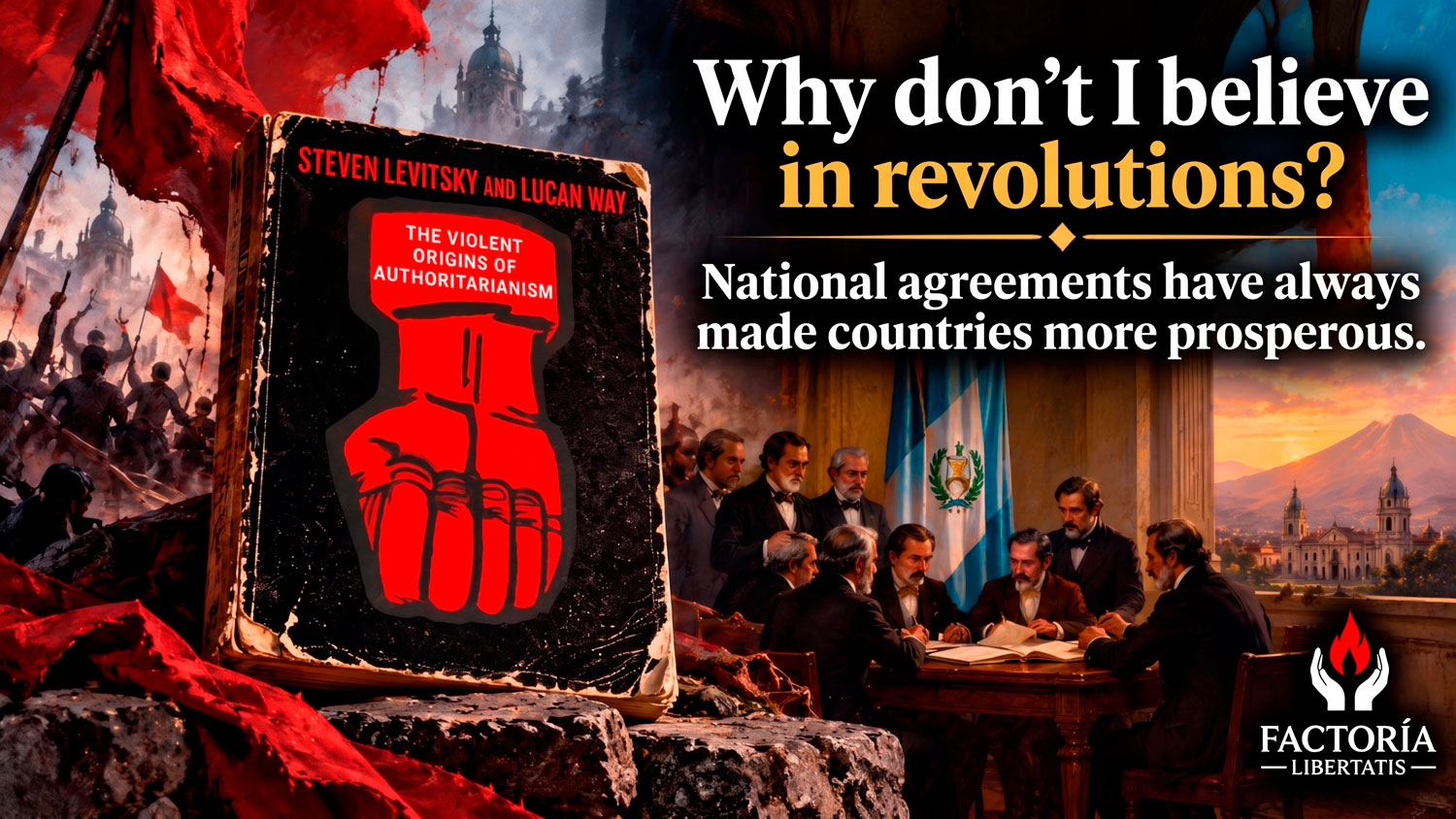
In their book Revolution and Dictatorship (2022), the political scientists Steven Levitsky and Lucan Way compared the dictatorships born of social revolutions since 1900 with all the others. The revolutionary ones last almost three times longer. Seventy-one percent exceed 30 years in power; among the rest, only 19%. Their statistical analysis confirms that revolutionary origin helps explain that longevity, even after accounting for oil, the economy, and regime type.
Angola, Cuba, Mozambique, and Vietnam were the four revolutionary regimes that received the most help from the Soviet Union. The Soviet Union disappeared in 1991. The four regimes survived. The war had fused the party with the army: where the two are practically the same thing, coups d’état become much harder. Levitsky and Way warn that these regimes also wear down, though slowly and incompletely. It took the Soviet Union 74 years to fall.
Cuba ranked 62nd in 1950 and 75th in 1959, the year of its revolution. In 2022 it had fallen to 111th, three places below Guatemala, under the same regime for 67 years. China, by contrast, rose from 129th in 1980 to 64th in 2022, after abandoning, starting in 1978, the economic program of its revolution. It has not left the dictatorship.
Levitsky and Way use the definition of revolution made classic by the sociologist Theda Skocpol. For a revolution to exist, three conditions must be met: the previous State collapses, the peasants mobilize en masse, and a new elite takes power and consolidates it. Cuba meets all three. So does China.
With those same criteria we can examine October 20, 1944.
Rodrigo Fernández Ordóñez examined that question in El asedio a la primavera (2026), his book on Arévalo. In the epilogue he analyzes the events of October 20 from three theoretical perspectives, including Skocpol’s, and concludes that they only partially meet the conditions of a revolution: what took place was “a mere urban insurrection.” The State remained standing, starting with the Army, which ended up dismantling the movement when it shifted toward the most radical left. Fernández Ordóñez makes clear that he is not trying to rename the event. Neither do I mean to diminish it, but its results do not correspond to the revolutionary transformation attributed to it.
October 20 is not the only event we call a revolution. In 1897 that name was given to the uprising in the west of the country against Reina Barrios, who had extended his term. Government troops retook Quetzaltenango in less than a week. In 1871 came the Liberal Revolution, the one that most set out to transform the country. Neither of the two meets the three conditions. But what 1871 left behind closely resembles what Levitsky and Way describe: during the following 73 years, three men — Justo Rufino Barrios, Manuel Estrada Cabrera, and Jorge Ubico — governed for 47 of them.
Every October 20, the list of social achievements we attribute to the Revolution of 1944 returns. In 2024, the official news agency celebrated the 78 years of the IGSS (the social security institute) as a “legacy of the Revolution of ‘44.” But the autonomy of the University of San Carlos had already been recognized by the Constituent Assembly of 1921, the first in Latin America to do so, according to the University itself. Ubico took it away in 1931 and the Junta of 1944 gave it back. The Labor Law of 1926 already granted mothers paid rest before and after childbirth. El Salvador granted women the vote in 1939, under the dictatorship of General Martínez. Panama and Costa Rica created their social security systems in 1941, five years before we did, and Nicaragua in 1955, with Somoza in power. These were reforms that the whole region was adopting, with revolution and without it.
In Costa Rica, those reforms were born of an agreement. On September 15, 1943, President Rafael Ángel Calderón Guardia, Archbishop Víctor Manuel Sanabria, and the Communist leader Manuel Mora rode together in a car to celebrate the Labor Code. In Guatemala, according to Fernández Ordóñez, all the politicians in 1944 agreed on organizing the workers, because they all wanted their votes.
I propose that we stop regarding revolutions as the solution to Guatemala’s problems and instead bet on agreements, on strengthening institutions, and on economic freedom. Starting January 22, when the 2027 elections are called, let us ask every candidate or party that promises to refound the country or make a revolution, publicly, in every forum and every debate, three things: Which institution would you change? Through what agreement? And with whom?
In August 1965, Lee Kuan Yew signed an agreement that pained him. In front of the journalists his voice broke. Singapore, Ireland, and Switzerland are today among the richest countries in the world, and all three got there through agreements. That is what Guatemala must build: a country where our children find opportunities without having to move away from the people they love.
Ramiro Bolaños, PhD. / President of the Centro de Pensamiento y Acción Factoría Libertatis
References
- Agencia Guatemalteca de Noticias, “78 años del IGSS, un legado de la Revolución del 44,” October 19, 2024 https://agn.gt/?p=383503
- “Delincuencia y seguridad social,” La Prensa (Panama) https://www.prensa.com/impresa/opinion/delincuencia-y-seguridad-social/
- “Día de la mujer hondureña,” El Heraldo (Tegucigalpa) https://www.elheraldo.hn/pais/574523-214/dia-de-la-mujer-hondurena
- “Doce antecedentes legales del IGSS,” Prensa Libre https://www.prensalibre.com/?p=460046
- Fernández Ordóñez, Rodrigo, El asedio a la primavera: Arévalo y la Revolución de 1944 (Guatemala: Wartime Books, 2026), pp. 447–449.
- Heritage Foundation, 2022 Index of Economic Freedom (Washington, D.C.: The Heritage Foundation, 2022).
- Lee Kuan Yew, transcript of the press conference of August 9, 1965, Broadcasting House, Singapore, National Archives of Singapore https://www.nas.gov.sg/archivesonline/data/pdfdoc/lky19650809b.pdf
- Levitsky, Steven, and Lucan Way, Revolución y dictadura. Los orígenes violentos del autoritarismo, trans. Guillem Gómez Sesé (Barcelona: Ariel, 2025), pp. 51–55.
- Maddison Project Database, 2023 version (Groningen: Groningen Growth and Development Centre, University of Groningen), sheet GDPpc.
- Mejía Dávila, Marco Vinicio, “Orígenes y alcances de la autonomía universitaria,” Revista Análisis de la Realidad Nacional (IPNUSAC), year 11, no. 236 (2022), pp. 4–8.
- Portal Latinoamericano (Universidade de São Paulo), entries “Calderón Guardia, Rafael Ángel” and “Mora Valverde, Manuel” https://sites.usp.br/portalatinoamericano/es/calderon-guardia-rafael-angel
- RTÉ Archives, “Programme for National Recovery” https://www.rte.ie/archives/exhibitions/1861-strikes-pickets-and-protests/470324-programme-for-national-recovery/
- Skocpol, Theda, States and Social Revolutions (Cambridge: Cambridge University Press, 1979).
- “Social Security in Central America,” Social Security Bulletin, 20.11 (1957) https://ssa.gov/policy/docs/ssb/v20n11/v20n11p11.pdf